
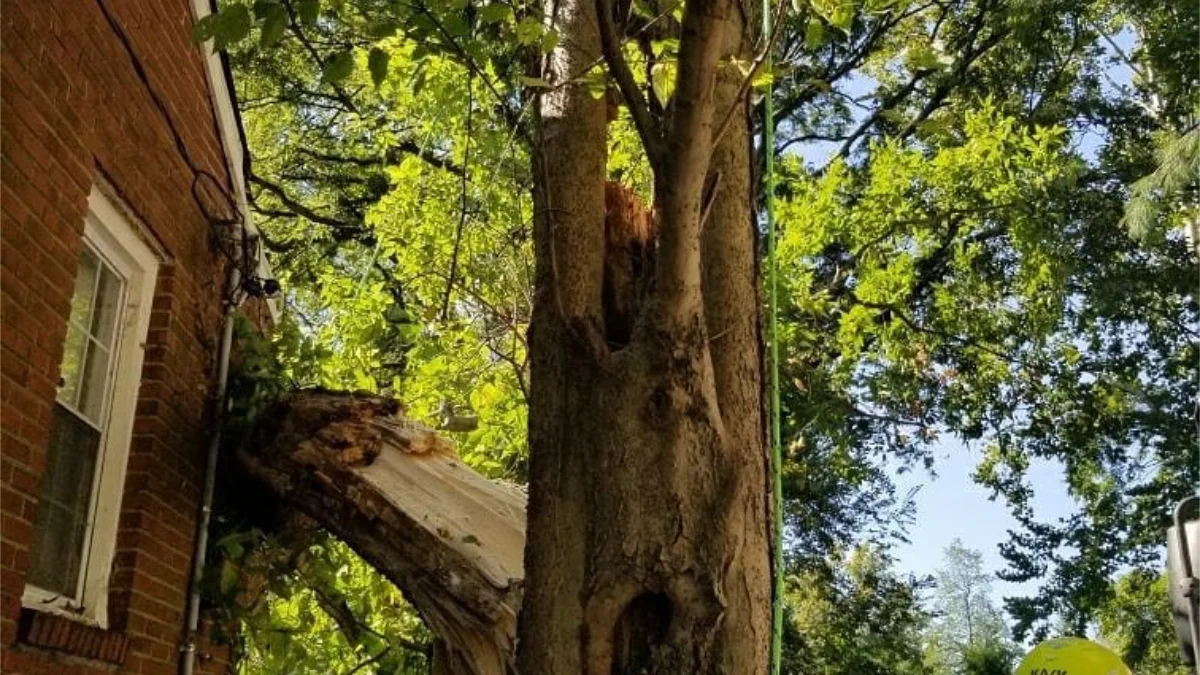
A mature tree is a beautiful addition to any property, providing shade, increasing property value, and anchoring the landscape. However, when a tree becomes structurally compromised, it transforms from an asset into a severe liability. Trees do not fall without a reason, and in almost every case, there are warning signs visible long before a catastrophic failure occurs.
Ignoring these signs is a dangerous gamble. A failing tree threatens your home, your vehicles, and the safety of your family. Understanding how to identify a high-risk tree allows you to take proactive measures, whether that means targeted pruning, cabling, or full hazardous tree removal. This guide highlights the critical red flags that indicate your tree is a safety risk and requires immediate professional attention.
A Sudden or Severe Lean
Not all leaning trees are dangerous. Many trees naturally grow at a slight angle to reach available sunlight. However, a tree that suddenly develops a lean, or one that is leaning increasingly further over time, is an active hazard. This indicates that the root system is failing and can no longer anchor the massive weight of the canopy.
Inspect the ground around the base of the leaning tree. If you see the soil heaving, cracking, or lifting on the side opposite the lean, the roots are actively tearing out of the ground. A tree in this condition is highly unstable and requires emergency tree service before it collapses completely.
Fungal Growth at the Base
Mushrooms might look harmless, but when they grow directly on the trunk or around the immediate base of a tree, they are a major warning sign. Fungi, such as conks and shelf mushrooms, feed on decaying organic matter. Their presence indicates that the tree is rotting from the inside out.
This internal decay hollows out the structural core of the tree, severely compromising its ability to withstand high winds or the weight of its own canopy. A tree with extensive fungal growth may look healthy and green on the outside, but it is structurally hollow and highly susceptible to snapping at the base.
Deep Cracks and Structural Splits
Inspect the main trunk and the points where large branches attach to the tree (the unions). Deep, vertical cracks in the trunk are a sign of severe structural stress, often caused by extreme temperature fluctuations or wind torsion. If the crack extends deeply into the wood, the tree’s integrity is compromised.
Similarly, look closely at V-shaped branch attachments. These are inherently weaker than U-shaped attachments and are prone to splitting. If you see a crack forming at the junction of a major limb, that limb is actively failing. Removing the limb or, in severe cases, the entire tree is necessary to prevent it from crashing down.
Extensive Deadwood and Hanging Branches
A healthy tree will occasionally shed small twigs, but large, dead branches remaining in the canopy are a serious threat. These branches, often referred to as ‘widowmakers,’ are brittle and can snap and fall at any moment, even on a calm, windless day.
If a tree has significant dieback-meaning large sections of the upper canopy are bare and dead while the lower sections remain green-the tree is in severe decline. Professional tree trimming is required immediately to remove the deadwood and mitigate the hazard, and a full assessment is needed to determine if the tree itself can survive.
Damaged or Severed Roots
A tree is only as stable as its root system. Construction projects, trenching for utilities, or even heavy equipment driving over the lawn can sever or crush a tree’s structural roots. Because the damage is underground, it often goes unnoticed until the tree begins to lean or die back.
If a significant portion of the root system has been damaged, the tree loses its anchor and its ability to absorb water. A tree with compromised roots is highly unpredictable and poses a major risk during storms. If construction has occurred near your trees, a professional risk assessment is essential to determine their stability.
Frequently Asked Questions
How do I know if a tree needs to be removed?
If a tree exhibits a sudden lean, extensive internal decay (indicated by fungal growth), deep structural cracks, or severe root damage, it likely needs to be removed. These are signs of irreversible structural failure. The Tree Experts of Tennessee provides professional tree risk assessments across the Greater Nashville area to give you an honest evaluation of whether a tree can be saved or requires safe removal.
Is a hollow tree always a safety risk?
Not necessarily, but it requires professional evaluation. Trees can survive with some internal hollowing, as the living tissue is just beneath the bark. However, if the hollow area is extensive, the tree loses its structural strength and becomes a severe hazard. The Tree Experts of Tennessee can assess hollow and decaying trees throughout Middle Tennessee to determine their failure potential.
What should I do if a large branch is hanging from my tree?
Do not walk under it and do not attempt to remove it yourself. A hanging branch, or widowmaker, is incredibly dangerous and can fall without warning. Contact The Tree Experts of Tennessee immediately for hazardous tree removal or emergency trimming. We serve Davidson, Williamson, and surrounding counties with the equipment to remove these hazards safely.
Can a leaning tree be fixed?
If a mature tree has suddenly developed a lean due to root failure or storm damage, it cannot be fixed or pulled back upright; it must be removed. If a young tree is leaning slightly, it may be corrected with proper staking. The Tree Experts of Tennessee evaluates leaning trees across the Greater Nashville area to determine the safest course of action.
Do you remove high-risk trees near houses?
Yes, removing high-risk trees near structures is our specialty. We use advanced rigging techniques, bucket trucks, and controlled dismantling to safely remove dangerous trees without damaging your home or property. The Tree Experts of Tennessee executes complex hazardous tree removals with precision and strict safety standards across Middle Tennessee.
Eliminate Tree Hazards Before They Fail
Do not wait for a high-risk tree to cause catastrophic damage to your home or property. The Tree Experts of Tennessee provides expert risk assessments and safe, controlled hazardous tree removal across the Greater Nashville area. We identify the risk and eliminate it safely.